Newborn photos at home: a simple, safe DIY guide
You can take lovely newborn photos at home with your phone, a window and a plain blanket. The setup takes about ten minutes. Keep your baby safe and comfortable, and stop as soon as they have had enough.
Choose a calm moment
Try right after a feed, when your baby is warm, full and sleepy. Many newborn photographers prefer to work in the first two to three weeks, when babies sleep deeply and curl up easily. If your baby is older, the same setup still works. Awake, alert photos can be just as precious.
Keep your baby dressed or loosely wrapped in what they normally wear. If you want a nappy-only photo, warm the room first and keep it short.
Set up by a window
- Use soft daylight. Place your baby near a window with light coming from the side. Keep direct sun off their face. A sheer curtain softens bright light.
- Turn off ceiling lights. Lamp light mixed with daylight can make skin look orange or grey.
- Keep the background plain. A cream, white or pale blanket hides the clutter of a busy room. Plain sleepsuits work better than bold prints or logos.
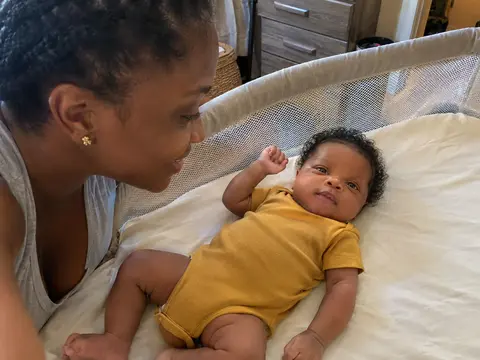
Keep newborn poses simple and safe
The safest DIY newborn photos are the simple ones:
- Your baby on their back on a firm, flat surface, such as their cot mattress or a blanket on the floor.
- Your baby in a parent's arms or resting on a shoulder, with the head supported.
- Close-ups of hands, feet, lips and hair.
Skip the poses you see in studio portfolios, such as a baby resting their chin on their hands or lying in a sling hanging from a branch. A newborn can't support their own head, so trained photographers build those images as composites from several supported shots. PetaPixel explains why unsupported poses are risky.
Stay within arm's reach the whole time, and never leave your baby on a bed edge, table or sofa. When they fall asleep, lay them on their back on a firm, flat surface without pillows, loose blankets or soft toys, as the American Academy of Pediatrics recommends.
Get the most from your phone camera
- Wipe the lens with a soft cloth.
- Turn the flash off.
- Use the main 1× camera. The wide lens can stretch faces near the edge of the frame.
- Tap your baby's face to focus. If the skin looks washed out, slide the brightness down a little.
- Take a burst of photos. Newborn expressions change in a second.
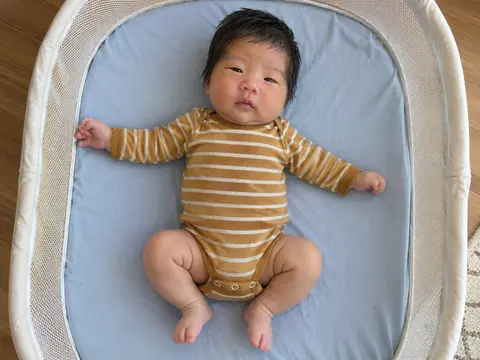
- Try two heights: straight above for a full-body view, and at your baby's level for a profile.
Keep the originals in your camera roll. Screenshots and photos sent through messaging apps are often compressed, and fine details such as eyelashes get lost.
A 10-minute newborn photoshoot at home
- Feed, burp and change your baby.
- Warm the room and switch off the overhead lights.
- Lay a plain blanket on the floor or the cot mattress near a window.
- Take a few full-body photos from above.
- Move in for close-ups of hands, feet and profile.
- Finish with photos in a parent's arms.
- Stop when your baby fusses or wakes hungry. You can try again tomorrow.
From home photos to a studio-style portrait
Everlittle turns photos like these into five studio-style newborn portraits. We use AI tools to build the setting, and every portrait is finished by hand. Send 3 to 5 clear originals that show your baby's face from slightly different angles. Our guide to choosing photos helps you narrow them down, and the gallery shows finished examples.

If you're weighing up a studio session as well, see how much newborn photography costs.
Frequently asked questions
When is the best time to take newborn photos at home?
Right after a feed, when your baby is warm and sleepy. Many newborn photographers prefer the first two to three weeks, when babies curl up easily, but the same simple setup works at any age.
Can I take good newborn photos with my phone?
Yes. Turn off the flash, use the main 1× camera, tap your baby's face to focus and use soft window light. Keep the original files rather than screenshots.
Which newborn poses are safe to try at home?
Keep to simple poses: your baby on their back on a firm, flat surface, held in a parent's arms with the head supported, and close-ups of hands and feet. Leave chin-on-hands and hanging poses to trained photographers, who create them as composites.
What should my baby wear for home photos?
A plain sleepsuit or a soft wrap in a light colour. Bold prints and logos pull attention away from your baby's face.